
What breed is my mixed or rescue dog, from a photo?
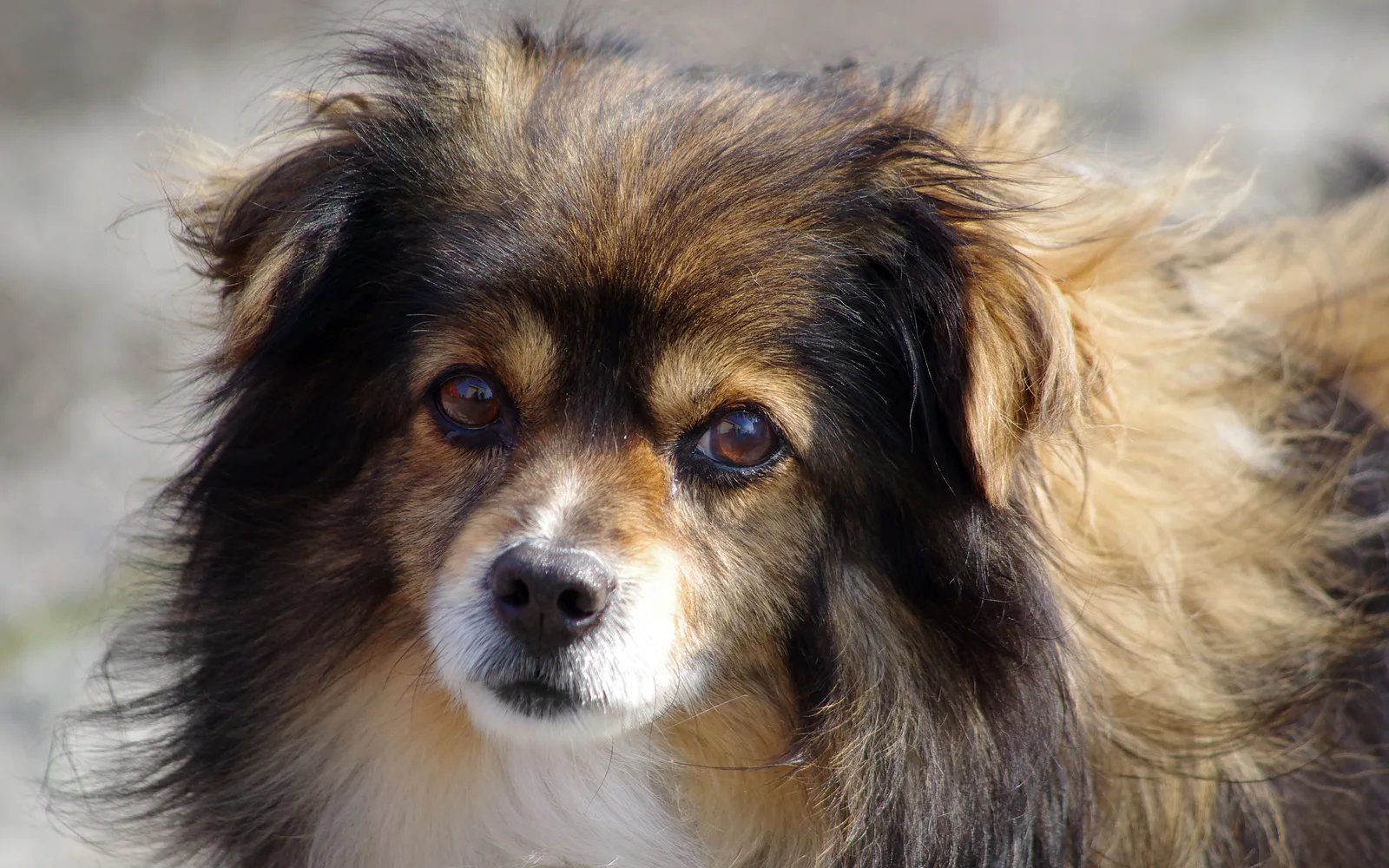

A mixed or rescue dog usually carries several breeds in its ancestry, often in very uneven amounts, and that is exactly what makes it hard to breed-ID from a photo. A large shelter study found 125 distinct breeds across just two shelters' worth of dogs, with only 4.9% of those dogs purebred (Gunter, Barber and Wynne, 2018). A photo can only show you the parts of that mix that happen to be visible.
Key points
- Most shelter dogs are mixed breed with unknown history, not a single clean cross (Gunter, Barber and Wynne, 2018).
- Coat length, ear shape and body size are driven by a small number of genes (Boyko et al., reported in Gunter, Barber and Wynne, 2018), so a visible trait can come from one distant ancestor while the rest of the mix stays invisible.
- Shelter staff in published studies could often name one breed correctly, but accuracy for naming a second or third breed dropped sharply.
- The more a dog's DNA leaned toward one visually distinctive breed, the easier it was for people to guess correctly; the study did not test other breed mixes this way.
- A photo-based guess is an estimate of resemblance, not a genetic result, and it is not a substitute for a DNA test or a vet.
Why is a mixed or rescue dog's breed so hard to tell from a photo?
Most dogs that end up in shelters arrive as strays or surrenders with no paperwork, and their breed history is simply unknown (Gunter, Barber and Wynne, 2018). When staff have to guess, they lean on what's visible: "size, weight, musculature, legs, tail and coat," as one study of shelter identification practice put it (Gunter, Barber and Wynne, 2018). Those are real, visible clues, but they are also only a handful of traits standing in for an entire family tree.
In the same study, DNA testing of 919 dogs at two shelters turned up 125 distinct breeds in total, and the three most common breed signatures, American Staffordshire Terrier, Chihuahua and Poodle, made up 42.5% of all the breed calls at the great-grandparent level (Gunter, Barber and Wynne, 2018). In other words, a handful of popular breeds reappear constantly in mixed ancestry, but the rest of the mix is a long tail of breeds that a glance simply cannot separate out.
What can coat and body shape actually suggest?
Coat colour, coat length and ear carriage are visible, and they do sometimes point toward a real ancestor; a dog with a double coat and upright ears may well have a spitz-type breed somewhere in its background. The problem is that traits such as coat length and ear type are controlled by a relatively small number of genes (Boyko et al., reported in Gunter, Barber and Wynne, 2018), so a dog can inherit a distinctive coat from one ancestor while carrying genetic material from four or five other breeds that leave no visible mark at all. A matching look is a clue worth noting, not a confirmed ancestor.
Body size and build work the same way. A stocky, broad-headed dog looks like it could be part of a "bully" type breed, and sometimes it is, but research backs up just how shaky that leap can be: one study found shelter staff collectively called 52% of 120 dogs "pit bull-type" by eye, while DNA signatures identified only 21% of the same dogs that way (Olson et al., 2015). The researchers concluded plainly that visual identification of pit bull-type dogs was unreliable. For more on how that specific comparison plays out against DNA testing generally, see how a photo-based guess compares with a DNA test.
How well do experienced people actually agree with DNA results?
Better than chance, but with real limits. In an early study of 20 dogs of unknown parentage, adoption agencies named one or two specific breeds for 16 of them; DNA testing confirmed that named breed as a predominant ancestor in only 4 of those 16 dogs, 25% (Voith et al., 2009). DNA testing also failed to detect every single breed that had been named in 87.5% of the 16 dogs. A follow-up study showed video of those same 20 dogs to a wider group of dog professionals, and on average fewer than 30% could name even one breed that the DNA results later confirmed (reported in Gunter, Barber and Wynne, 2018).
| What was being named | Visual result | DNA result |
|---|---|---|
| One or two specific breeds per dog (Voith et al., 2009) | 16 of 20 dogs assigned named breeds by an adoption agency | DNA confirmed the named breed in only 4 of those 16 (25%) |
| "Pit bull-type" or not (Olson et al., 2015) | Shelter staff collectively called 52% of 120 dogs pit bull-type | DNA signatures identified 21% of the same dogs that way |
| Any one breed, then more than one (Gunter, Barber and Wynne, 2018) | Staff matched at least one breed for 67.7% of dogs | That dropped to 10.4% when asked to match more than one breed |
Does a more "typical" looking dog get guessed more accurately?
Yes, and this is one of the clearer findings in the research. Gunter, Barber and Wynne (2018) found that as the share of a visually distinctive breed (like a pit bull-type breed) in a dog's actual DNA went up, shelter staff got noticeably better at calling it correctly. Gunter, Barber and Wynne (2018) did not measure this for other breeds, but it fits the wider finding that staff rarely named more than one breed correctly (10.4%). If your rescue dog looks like a genuine "blend" rather than a clear single type, that is often exactly why a photo-based guess struggles with it.
So what should you actually do if you want to know your dog's mix?
Start by treating any visual guess, yours, a friend's, a shelter's, or an app's, as an opinion, not an answer. A clear, well-lit, well-framed photo at least gives a visual guess the best chance of being useful; a blurry or badly cropped one gives it almost nothing to work with. See how to photograph your pet so a photo actually shows its breed-typical traits for the specifics. If you need a confirmed answer, for a landlord's breed policy, an inherited health screen, or just to settle a family argument, a DNA test or documented pedigree is the only method discussed in the research above that was ever used as the standard of truth. A photo-based read, including a free first Origin Story in the Furrigins app, can give you a quick, fun, visual starting point. It is not a DNA test, not a pedigree, and not veterinary advice, so treat the result as a guess worth checking, not a verdict.
Frequently asked questions
Why is it so hard to tell what breeds are in a mixed dog?
Because most of a mixed-breed dog's ancestry doesn't show up as an obvious visual blend. One study of 919 shelter dogs found 125 distinct breeds in their DNA, yet only a handful of strongly represented breeds tend to dominate what a dog visibly looks like.
Can coat length tell you a dog's breed?
Coat length is controlled by a small number of genes (Boyko et al., reported in Gunter, Barber and Wynne, 2018), so it can be inherited from a great-grandparent whose other genes left no visible trace at all. A matching coat is a clue, not proof.
Are shelter staff good at guessing a dog's breed by eye?
Published studies found shelter staff could often name one breed that was genuinely in a dog's ancestry, but agreement fell sharply when asked to name more than one breed.
Is a visual guess the same as a DNA result?
No. A visual guess is an estimate of resemblance. A DNA test reads genetic markers against a reference panel. For a mixed or rescue dog with unknown parentage, only a DNA test or documented pedigree can confirm ancestry; a photo can only suggest it.
Does a bigger, blockier-looking dog mean more of a certain breed?
Not reliably. Research found staff matched DNA more often as a dog's pit bull-type ancestry increased; it did not show that size or build alone predicts breed.
References
- Gunter, L.M., Barber, R.T. and Wynne, C.D.L. (2018) 'A canine identity crisis: Genetic breed heritage testing of shelter dogs', PLOS ONE, 13(8), e0202633. Available at: https://journals.plos.org/plosone/article?id=10.1371/journal.pone.0202633 (Accessed: 6 November 2026).
- Olson, K.R., Levy, J.K., Norby, B., Crandall, M.M., Broadhurst, J.E., Jacks, S., Barton, R.C. and Zimmerman, M.S. (2015) 'Inconsistent identification of pit bull-type dogs by shelter staff', The Veterinary Journal, 206(2), pp. 197-202. Available at: https://pubmed.ncbi.nlm.nih.gov/26403955/ (Accessed: 6 November 2026).
- Voith, V.L., Ingram, E., Mitsouras, K. and Irizarry, K. (2009) 'Comparison of adoption agency breed identification and DNA breed identification of dogs', Journal of Applied Animal Welfare Science, 12(3), pp. 253-262. Available at: https://pubmed.ncbi.nlm.nih.gov/20183478/ (Accessed: 6 November 2026).